An emergency medicine education platform for clinicians and trainees — for educational use only, not a substitute for clinical judgement or formal medical advice.
EDAITUTOR
ED Procedures · 04v0.1 · illustratedEducational use only
Procedural Sedation
Safe, depth-controlled sedation for brief, painful or distressing ED procedures in adults and children — assess, plan one level deeper, monitor, and be ready to rescue the airway.
🔴 Before you start
Sedation is a continuum — you cannot reliably stay at one point, so plan, staff and equip for one level deeper than you intend. You need a dedicated sedationist whose only job is the airway and the patient, and a separate proceduralist — never sedate solo. Resus bay, full monitoring (including waveform capnography), a checked airway trolley and reversal drugs ready before the first dose.
Depth of sedation — it is a continuum, not a switch (ANZCA PS09)
Minimal
Anxiolysis. Responds normally to voice. Airway & ventilation unaffected.
Ketamine. Trance-like cataleptic state; reflexes & breathing usually preserved. Sits outside the continuum.
e.g. ketamine ≥1 mg/kg IV
Deep
Purposeful response only to repeated / painful stimulus. Airway may need support; ventilation may be inadequate.
e.g. propofol bolus
General anaesthesia
Unrousable, even to pain. Airway & ventilation support required. Not a target for ED PSA.
rescue: BVM → LMA → ETT
⚪ key principleYou cannot reliably hold a patient at one point on the continuum. Plan, staff and equip for one level deeper than your target depth, and titrate slowly to effect. Source: ANZCA PS09 · ACEP procedural sedation policy.
University of Michigan Sedation Scale (UMSS)
Score
State
Response
0
Awake / alert
Normal
1
Minimally sedated
Tired / sleepy, appropriate response to voice
2
Moderately sedated
Somnolent, easily roused by light touch / voice
3
Deeply sedated
Roused only by significant physical stimulus
4
Unrousable
No response — manage as GA
Use it to record baseline, depth during the procedure, and recovery. Discharge when back to the pre-sedation UMSS. Source: Malviya / UMSS (validated paediatric & adult sedation scale).
Good candidates / indications
Fracture & joint reductions (Colles', ankle)
Shoulder / hip / patella dislocation relocation
Incision & drainage of abscess
Lumbar puncture (esp. children)
DC cardioversion (brief, deep)
Complex laceration repair · burns dressing
Foreign-body / tube removal · paraphimosis
Imaging or a procedure needing the child to stay still
⚪ consensusBest for short, painful or distressing procedures where the patient is otherwise well and the airway is reassuring.
🟢 ACEM · LITFL · RCH · DFTB
Don't / department stop-criteria
No second clinician — can't staff a sedationist + proceduralist
Upper-lip-bite test — can't cover upper lip with lower incisors = predicts difficulty
Beard, obesity, short/large neck, small mouth, retrognathia, prior difficult airway
🟡 evidenceThe upper-lip-bite test is the single strongest bedside predictor (class III, +LR ≈ 14); Mallampati 3–4 +LR ≈ 4. Source: Detsky ME et al. JAMA 2019 (Rational Clinical Examination).
🟡 fastingFasting status alone should not be a barrier to, or reason to delay, ED procedural sedation. ASA fasting rules were written for elective GA and are not validated for emergency PSA — there is no good evidence that fasting reduces aspiration in this setting. Balance urgency, planned depth and aspiration risk, and document the reasoning. Source: Green SM et al. Ann Emerg Med 2019 · ACEP.
Increased risk of negative outcome
Extremes of age — the very young & the elderly
Difficult facial or neck anatomy — anticipated difficult BVM ventilation or intubation
Patients with significant underlying disease states
Previous anaesthetic / sedation difficulty
⚪ cautionThese features warrant extra caution and early senior involvement. Keep a low threshold for GA in theatre over ED procedural sedation, or to defer until the situation is optimised.
🟡 ACEM · ANZCA PS09 · LITFL
Preparation & monitoring — set up before the first dose
Team & space
Resus bay. Dedicated sedationist (airway only) + separate proceduralist. Trained assistant. Shared plan / time-out.
IV access & flush. Reversal: naloxone, flumazenil. Rescue: suxamethonium, atropine, adrenaline, IV fluids. Antiemetic drawn up.
🟢 ANZCA PS09
🟢 monitoringAdd waveform capnography to standard monitoring: it detects hypoventilation / apnoea before SpO₂ falls — particularly valuable under drapes or for deep sedation. Pre-oxygenate and give supplemental O₂. Source: ANZCA PS09 · ACEP · EMCrit.
Agents — drug-of-choice by scenario
Reductions / dislocations
Ketamine (dissociative) — first-line in children; or propofol + fentanyl in adults.
deep, brief, very painful
Needs stillness (LP, I&D, imaging)
Propofol titrated, or ketamine — choose by haemodynamics & analgesia need.
moderate–deep
Minor / short (lacerations)
Nitrous oxide 50–70% ± local anaesthetic. Rapid on/off, child-friendly.
minimal–moderate
DC cardioversion
Propofol or ketamine — very brief deep sedation; pre-oxygenate, anticipate apnoea.
brief deep
⚪ principleThere is no single "best" agent — match the drug to the depth, duration and analgesia needed, the patient's physiology, and your familiarity. Titrate slowly; combinations (e.g. propofol + opioid) compound respiratory depression.
Emergence phenomena — commoner in adults; calm environment, treat distress with low-dose midazolam (not routine prophylaxis, esp. in children)
Hypersalivation — anti-sialagogue (atropine/glycopyrrolate) not routinely needed
Antiemetic: ondansetron 0.15 mg/kg (max 8 mg) IV reduces vomiting
🟢 RCH · DFTB · LITFL · ACEP
Propofol
Dose
Induction: 0.5–1 mg/kg IV over 1–2 min
Titration: 0.5 mg/kg IV q1–3 min to effect
Reduce dose in the elderly & haemodynamically marginal
🟡 cautionDose-dependent apnoea & hypotension. No analgesia — pair with local or an opioid. Pre-oxygenate & titrate.
Notes
Rapid on/off — ideal for brief deep sedation & cardioversion
Pain on injection (lignocaine co-administration helps)
PRIS (propofol infusion syndrome) — a concern with prolonged high-dose infusions, not single ED boluses, but be aware
Egg/soy allergy — modern formulations low risk
🟢 LITFL · RCH · Deranged Physiology
Midazolam
Dose
IV: 0.02–0.05 mg/kg, titrated slowly (wait 1–2 min between doses)
Anxiolysis & amnesia — minimal analgesia
🔴 reversalFlumazenil 0.01 mg/kg (max 0.2 mg) IV, repeat to ~1 mg max. Caution: may precipitate seizures in benzo-dependence / co-ingestion — use selectively, not routinely.
🟡 synergyProfound additive respiratory depression with opioids — give smaller doses, slower, and watch capnography.
Note: RCH paediatric conscious-sedation protocols may titrate to 0.1 mg/kg (max 2.5–5 mg) — confirm against your local protocol.
🟢 LITFL · RCH
Nitrous oxide (N₂O)
Dose
50–70% inhaled (Entonox = fixed 50/50; up to 70% via blender)
Self-administered demand valve where able; scavenging required
🟢 RCH · DFTBMinimal–moderate sedation + analgesia, rapid on/off — excellent for minor / short procedures and cooperative children.
🟡 cautionAnalgesia, not sedation. Additive respiratory depression with propofol / midazolam — go slow, smaller doses.
🔴 reversalNaloxone 0.4 mg IV titrated (adult); 0.1 mg/kg (max 0.4 mg) paeds. Short half-life — re-dose / observe for re-sedation.
🟢 LITFL · RCH
Rescue / adjunct drugs
Suxamethonium (laryngospasm) — 1–2 mg/kg IV, or 3–4 mg/kg IM if no IV
Atropine 0.02 mg/kg IV (max ~0.5–0.6 mg) for bradycardia
Ondansetron 0.15 mg/kg (max 8 mg) IV — antiemetic
Naloxone — opioid reversal (see opioid card)
Flumazenil — benzodiazepine reversal (see midazolam card)
Adrenaline & IV fluids — for anaphylaxis / hypotension
⚪ have-readyDraw up rescue drugs & calculate weight-based doses before sedation — not during the crisis.
🟢 LITFL · DFTB · RCH
Paediatric specifics — ketamine country
Principles
Ketamine is first-line for paediatric PSA — wide safety margin, preserves the airway
No routine midazolam prophylaxis — emergence phenomena are uncommon in children and prophylactic benzo may increase adverse events / vomiting
Nitrous needs cooperation — generally ≥ 1 yr for delivered N₂O; self-administration usually ≥ 5 yr; caution < 2 yr; max 70%
Everything is weight-based; use the smallest effective dose
Non-pharmacological first (distraction, parents, topical/local anaesthetic)
Atropine 0.02 mg/kg only if bradycardic — not a routine pre-med
Paediatric quick doses
Agent
Dose
Ketamine IV
1–1.5 mg/kg over 1–2 min; top-up 0.5 mg/kg
Ketamine IM
4 mg/kg (RCH; some quote 4–5)
Propofol IV
0.5–1 mg/kg then 0.5 mg/kg titration
Midazolam IV
0.05–0.1 mg/kg (max 2.5 mg) titrated
Nitrous oxide
50–70% inhaled (cooperation needed)
Ondansetron IV
0.15 mg/kg (max 8 mg)
Always confirm against the RCH / local weight-based guideline before drawing up.
🟢 paeds sourceDoses anchored to the RCH Clinical Practice Guidelines (Ketamine & Procedural Sedation) and Don't Forget the Bubbles. Verify the current local protocol — paediatric dosing is updated periodically.
Intranasal dexmedetomidine (paediatric)
🟢 what it isSelective α₂-adrenoceptor agonist — sedation + anxiolysis with minimal respiratory depression. Increasingly used in paediatric ED for minimally painful or distressing procedures, imaging (CT / MRI), EEG, and as premedication. Particularly useful in anxiety, autism spectrum disorder, and children at risk of emergence delirium.
Dose — intranasal
1–4 microgram/kg (max 200 microgram) as a single dose via mucosal atomisation device (MAD)
Give 30–60 min before the procedure; onset ~30–45 min
For children ≥ 10 kg and ≥ 1 year
Divide between both nostrils if volume > 1 mL (> 100 microgram)
🟡 cautionNot an analgesic — add analgesia for painful procedures. Slow onset — plan ahead; not for time-critical sedation.
Watch & precautions
Bradycardia & hypotension — usually mild / self-limiting after intranasal use, but monitor
🔴 IV = ICU onlyIV dexmedetomidine is critical-care only (loading 0.5–1 microgram/kg over ≥ 15 min; maintenance 0.1–1.4 microgram/kg/hr) — not routine ED procedural sedation.
⚪ monitoringDedicated nurse / doctor, continuous SpO₂ + HR, baseline obs + UMSS, then 15-minutely obs until back to baseline.
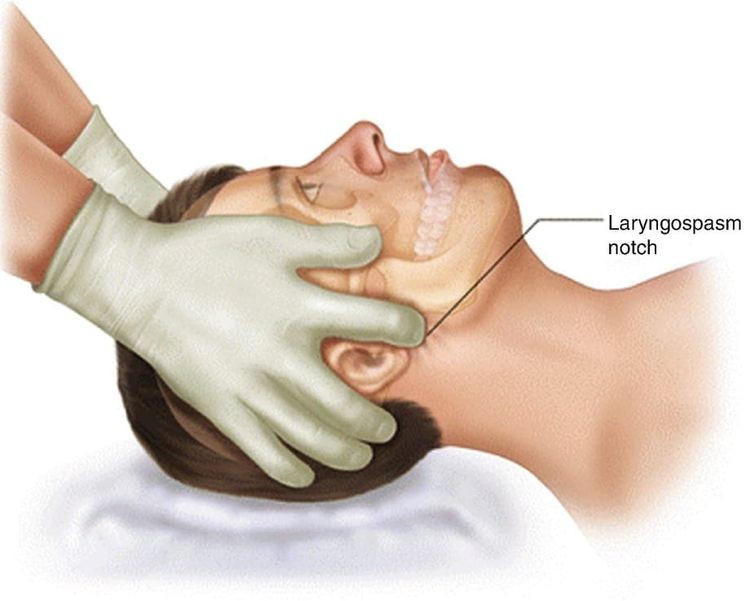
Signs: stridor, ↓SpO₂, paradoxical / tracheal-tug effort, silent chest if complete. Manage: stop the stimulus → 100% O₂ → jaw thrust + CPAP → Larson's manoeuvre (firm pressure in the notch behind each earlobe, between mastoid & mandibular ramus). If it persists → suxamethonium 1–2 mg/kg IV. If no IV access → suxamethonium 3–4 mg/kg IM injected into the tongue (intralingual); intraosseous is an alternative if available. Add atropine 0.02 mg/kg if bradycardic; ventilate / prepare to intubate. Laryngospasm may recur as the neuromuscular blockade wears off — keep watching.
Apnoea · hypotension · vomiting
Apnoea / hypoventilation — capnography detects it first; stimulate, jaw thrust, BVM, reduce dosing; reverse if opioid/benzo
Hypotension — usually propofol; IV fluids, reduce dose, reassess, leg-raise
Vomiting / aspiration — suction ready, position, ondansetron (esp. ketamine), suction & reposition if it occurs
Bradycardia — atropine 0.02 mg/kg IV
⚪ tipDesaturation? Look at the patient and the capnograph first — reposition the airway before reaching for drugs.
Most events are transient and respond to basic airway support & time. Stop, oxygenate, reassess — escalate only as needed.
🟢 evidenceSerious adverse events are uncommon and the great majority are managed with simple airway manoeuvres and oxygen. Early detection (capnography) and a prepared team are what keep it safe. Source: LITFL · DFTB · EMCrit · ACEP.
Recovery / discharge criteria
Back to pre-sedation UMSS / conscious level, oriented
Airway reflexes intact; vitals at baseline, SpO₂ maintained on room air
Tolerating oral fluids without nausea
Pain controlled
Ambulating at pre-sedation baseline (age-appropriate)
Adequate observation period completed
⚪ consensusRecover in a monitored area until criteria are met — recovery time tracks the agent's offset, not the procedure length.
🟢 ACEM · ANZCA PS09 · RCH
Safe discharge
Discharge into the care of a responsible adult
Written advice — who/when to call, red flags
No driving, operating machinery, alcohol or important decisions for ~24 h
Children — supervise closely; expect some drowsiness / ataxia after ketamine
⚪ safetyDo not discharge alone after sedation. If criteria aren't met, keep observing — late re-sedation can occur (esp. long-acting opioids after naloxone wears off).
🟢 ACEM · ANZCA PS09 · RCH
ED AI Tutor — ED Procedures Series · v0.1 · For clinician education only. Not a substitute for clinical judgement, local guidelines or senior oversight. Always verify drug doses, contraindications and discharge criteria against current institutional protocols.
Quick Look · Procedural SedationVisual overview
Tap the poster to zoom · tap again to fit. Visual summary only — read the full sections for context, cautions & sources. ⌨ Esc to close.